Global Recognition
KSMU is a state medical university in Russia, recognised in the WDOMS and internationally accredited using WFME-based standards.
MBBS in Russia · Kazan
MBBS at Kazan State Medical University in Kazan, Russia — fees, eligibility, the admission timeline and FMGE outcomes, explained for Indian students.
Overview
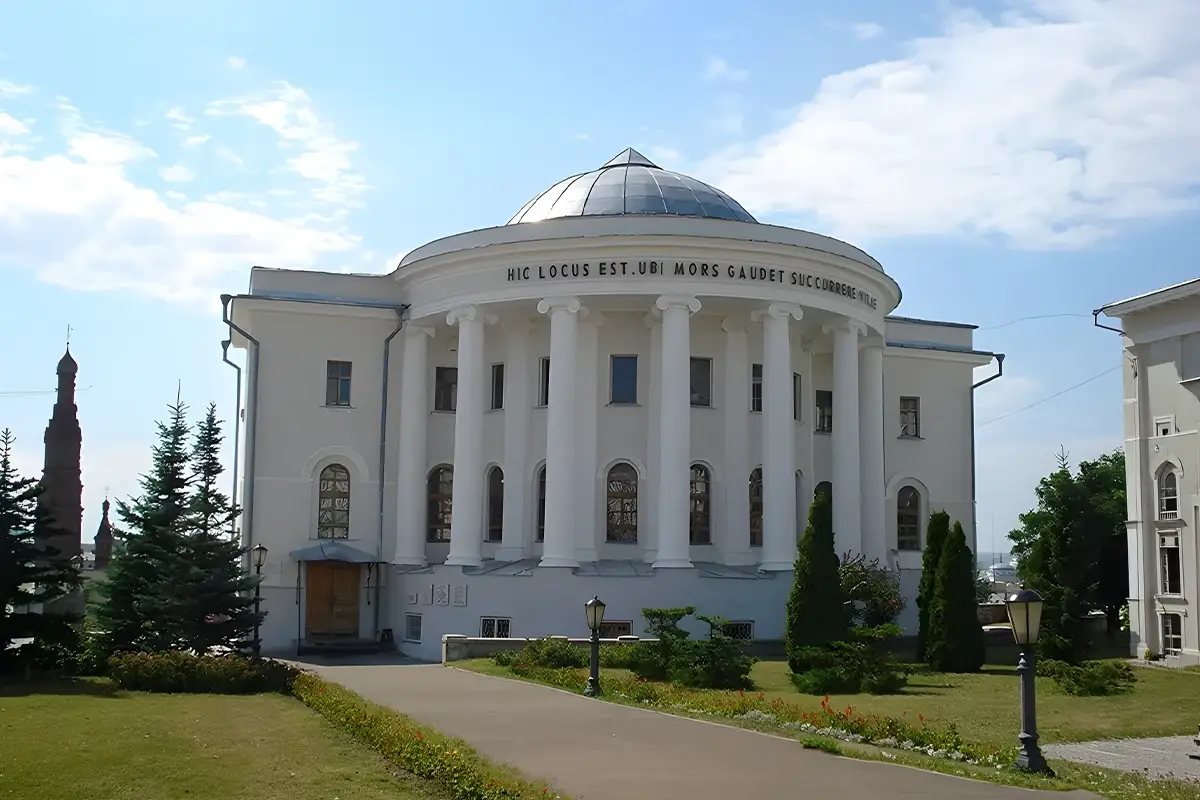
Kazan State Medical University (KSMU) is a public medical university located in Kazan, Russia, established in 1814. It is the best university for MBBS in Russia for Indian students. The six-year General Medicine program offered at KSMU is available in English at affordable fees for international students. KSMU is included in the World Directory of Medical Schools, is accredited by the Russian state, and has international institutional accreditation in line with WFME.
At a glance
| Particulars | Details |
|---|---|
| University name | Kazan State Medical University |
| Established | 1814 |
| Location | Kazan, Republic of Tatarstan, Russia |
| Course offered | General Medicine (MBBS equivalent) |
| Course duration | 6 years |
| Medium of instruction | English or Russian, depending on programme |
| Recognition | Russian State Accreditation, NMC (India) & WDOMS Approved |
| Eligibility | 50% in PCB at 10+2 (40% for SC/ST/OBC) plus a valid NEET score for Indian students |
| Intake | September intake |
| Application deadline | 15 July |
| Tuition (Year 1) | RUB 636,000 (Rs. 6,99,600) |
| Total students | 7,000+ students including 4000 international |
| Indian students | 1500+ |
| Countries represented | 50 |
KSMU is a state medical university in Russia, recognised in the WDOMS and internationally accredited using WFME-based standards.
KSMU offers General Medicine programmes taught in English, with a curriculum specific to General Medicine.
The affordable tuition fee for General Medicine at KSMU is only RUB 636,000 per year, and hostel charges are extra.
The students are given practical education in General Medicine using the teaching infrastructure and clinical centres of the university. Also, the Kazan State Medical University hostel is top-notch.
According to the university, there are more than 6,000 students and residents at the university, and one out of every five students is an international student.
KSMU has been running its international program in collaboration with overseas universities and clinical centres for a long time now.
Got a quick question?
Message us and skip the form. No details needed to start.
Recognition
Kazan State Medical University NMC approved along with WHO, and it is also listed in the World Directory of Medical Schools.
The degree availed is recognised in over 120 nations around the world. The graduates can take the FMGE or NExT in India, the USMLE in the United States, and the PLAB in the United Kingdom. NMC states that 54 months of education, 12 months of internship, English-language education, clinical rotation and teaching of listed subjects by NMC make a university NMC-approved.
The NMC prescribes 6 structural criteria for foreign medical education. These must be met before an Indian graduate can register to practise in India. This is how the KSMU programme maps against them.
| NMC requirement | Status |
|---|---|
| Minimum 54 months of theoretical instruction | Compliant |
| 12-month internship | Compliant |
| English as the medium of instruction | Compliant |
| All mandatory Schedule 1 subjects taught | Compliant |
| Degree awarded is a Primary Medical Qualification | Compliant |
| Internship completed at the university hospital | Compliant |
Replies within one working dayMon–Sat 10:00–19:00 IST
Not sat it yet? Put in the score you expect — you can redo this later.
The PCB average, not your overall percentage.
A counsellor will go through it with you and answer anything the numbers leave open.
Ranking
| Ranking body | World | Russia | Regional |
|---|---|---|---|
| uniRank | 5,868 | 213 | 5 |
| Webometrics | 4,976 | - | — |
| Edurank | 3812 | 80 | 3 |
uniRank's 2026 ranking ranks KSMU at 213 in Russia and 5,868 in the world. Webometrics 2026 ranking for July ranks KSMU at 4,976 in the world.
Fees
For the academic session of 2026/27, KSMU charges an annual fee of RUB 636,000 for six years General Medicine program conducted in the English language. Costs like accommodation, health insurance, visa, and personal expenditure will be extra. Let’s see in detail the Kazan State Medical University fee structure.
| Item | Amount (approx.) |
|---|---|
| Tuition — Year 1 | RUB 636,000 · ₹699,600 |
| Tuition — Years 2 to 6 (each) | RUB 636,000 · ₹699,600 |
| Hostel (per year) | RUB 80000 · ₹88,000 |
| Medical insurance & visa extension | RUB 12000 · ₹13,200 |
| Tuition across the full six years | RUB 3816000 · ₹41,97,600 |
| Overall 6-Year MBBS Budget | RUB 493,3000 · ₹54,26,300 |
| Food, flights & personal spending (6 years) | RUB 625,454 to RUB 774,545 · ₹6,88,000 to 8,52,000 |
Note: Converted at 1 RUB = ₹1.1 on 20 August 2026. Tuition is charged in rubles, so the rupee total moves with the rate. Most families fund this with an education loan. Indian banks lend against an NMC-recognised foreign medical seat.
Total cost of the six-year programme: about ₹40 lakh in university charges across six years — tuition, hostel and mandatory fees. Food, flights and personal spending add a further ₹4–16 lakh depending on how you live, which is what the calculator below works out.
The six-year cost sheet
PDF1 pages3.7 KB
Email only. No call unless you ask.
Replies within one working dayMon–Sat 10:00–19:00 IST
Where these figures come from
Tuition is only part of it. Add hostel, food and flights to see what six years actually costs you.
Your base tuition is fixed by the university. Customise the remaining options below to fit your needs, and watch the total update automatically.
Total across six years
₹0
The above values are subject to change due to currency fluctuations and market influence.
Want this as a one-page PDF you can show your family?
Get the fee sheetMost families fund this with an education loan. Indian banks lend against a recognised foreign medical seat.
Check your loan eligibilityLiving costs
| Item | Amount (approx.) |
|---|---|
| Hostel accommodation | RUB 80000 per year · ₹88,000 per year |
| Indian mess/tiffin service | RUB 96000 - 120000 Per Year · ₹1,05,600 - 132,000 per year |
| Self-catering | RUB 43636 - 54545 Per Year · ₹48000 - 60000 per year |
| Local transport | RUB 7300 Per Year · ₹8030 per year |
| One-time admin, visa, medical & biometrics | RUB 23000 · ₹25,300 |
NOTE: Living costs can change with inflation, exchange rates and individual spending habits. The above utilities cost is taken from unofficial sources. Hence, it may vary.
Eligibility
Admission
The Kazan State Medical University admission procedure commences, and the institution is accepting applications for its General Medicine course. Students must collect all the necessary documents required for the admission process and submit them before the deadline.
Fill in the application form, select the General Medicine course, and the mode of instruction.
Submit the required documents, such as academic documents and medical documents, among others.
The university will send an admission letter after the evaluation of the documents and application.
Make use of the visa documents to obtain the necessary Russian student visa.
Pay the Kazan State Medical University fee and make other arrangements.
| Stage | When |
|---|---|
| Applications open | 20 June |
| Application window | 20 June–15 July |
| Application deadline | 15 July |
| Review and entrance examination | July – August |
| Invitation letter and visa processing | August – September |
| Classes begin | September |
Before anything is submitted anywhere
Paperwork
Note: Where required, documents must be translated into Russian and notarised before submission.
Curriculum
| Stage | Phase | What you study |
|---|---|---|
| Years 1–2 | Pre-clinical | Anatomy, histology, physiology, biochemistry, medical biology, genetics, Latin and medical terms and fundamentals of clinical subjects. |
| Year 3 | Para-clinical | Pathology, pharmacology, microbiology, immunology, hygiene and many other disciplines that bridge basic sciences with clinical medicine. |
| Years 4–5 | Clinical | Internal Medicine, Surgery, Paediatrics, Obstetrics & Gynaecology, Neurology, Psychiatry, Dermatology, Ophthalmology and many more clinical disciplines. |
| Year 6 | Clinical/final training | Specialised clinical disciplines, hands-on learning, general practice and examinations for the medical degree. |
Outcomes
| Year | Appeared | Passed | Pass rate |
|---|---|---|---|
| 2025 | 228 | 73 | 32.02% |
| 2024 | 436 | 134 | 30.73% |
| 2023 | 395 | 92 | 23.29% |
| 2022 | 368 | 151 | 41.03% |
| 2021 | 305 | 138 | 45.25% |
| 2020 | 233 | 55 | 23.61% |
| 2019 | 166 | 55 | 33.13% |
| 2015–18 | 450 | 68 | 15.11% |
The statistics have been collected from the institute-wise reports of NBEMS. The FMGE performance is good evidence, although it is certainly not a guarantee of the student's performance. Beginning in 2026, students are also expected to follow the guidelines of NMC in respect to NExT and foreign graduate registration.
Programmes
six year
KSMU’s General Medicine course is a six-year full-time specialist medical degree offered either in English or Russian.
six year
This is a six-year course in pediatric medicine offered by KSMU for paediatric medicine through foundational, clinical and practical medical training.
five year
KSMU offers a five-year course in Dentistry offered either in English or the Russian language.
five year
This is a five-year Pharmacy course offered by KSMU offered in English or Russian.
six year
KSMU offers a six-year Preventive Medicine course together with Medical Biochemistry and Medical Biophysics specialist courses.
—
KSMU also offers Nursing and Allied Health programs. alongside its medical specialist degrees.
| Particulars | Details |
|---|---|
| Primary course | General Medicine |
| Duration | 6 years |
| Medium of instruction | English |
| Intake | September |
| Application deadline | 15 July |
| Degree awarded | Physician / Specialist qualification in General Medicine |
Student life
University hostels mostly use shared rooms, housing two to three students, with common facilities like kitchens and bathrooms.
The facilities provided in the hostels include common kitchens, bathrooms, heating systems and basic infrastructure. Students must be aware of the actual facilities in their assigned hostel.
KSMU has official hostel regulations concerning residence, behaviour, registration, and student responsibilities. The facilities are functional but not luxury-type.
There are recreational activities like participating in sports, joining student bodies, cultural functions, academic clubs and international student functions.
University hostels mostly use shared rooms, housing two to three students, with common facilities like kitchens and bathrooms. The facilities provided in the hostels include common kitchens, bathrooms, heating systems and basic infrastructure. Students must be aware of the actual facilities in their assigned hostel. KSMU has official hostel regulations concerning residence, behaviour, registration, and student responsibilities. The facilities are functional but not luxury-type. There are recreational activities like participating in sports, joining student bodies, cultural functions, academic clubs and international student functions. KSMU's student handbook mentions that KSMU hostel facilit
Rooms are allotted by the international office. Ask early if you want a specific block.
Replies within one working dayMon–Sat 10:00–19:00 IST
The city
Kazan is the capital of the Republic of Tatarstan and one of the largest cities of Russia, situated on the banks of the Volga. Kazan combines a high density of students with influences of Tatar and Russian culture, developed public transport, commercial establishments, hospitals, and universities. The KSMU campus is located on Butlerova Street in Kazan.
Kazan operates according to Moscow Standard Time (UTC+3). India is 2 hours 30 minutes ahead of Kazan throughout the year because Russia does not observe daylight saving time in Moscow.
Public transport in Kazan is well-developed and includes buses, trolleybuses, trams and the metro. In addition, students living near campus will be able to reach many facilities of the university by walking.
Kazan is a large university city that has developed public facilities and many students. However, international students are expected to comply with university rules, carry identity documents and follow the requirements of the Russian migration service.
Kazan has a continental climate with warm summers, cool transitional seasons and cold winters. Snow and freezing temperatures are usual during the winter period.
| Season | Typical range | What to expect |
|---|---|---|
| Summer (June – August) | 15°C to 27°C | Summer is pleasant because it has warm weather, more daylight and sometimes rain. |
| Autumn (September – October) | 5°C to 16°C | Temperatures can drop quickly, with cooler mornings and evenings. |
| Winter (November – March) | −5°C to −20°C | Winter brings cold weather and snow. Proper clothes and shoes are necessary. |
| Spring (April – May) | 4°C to 18°C | The temperature rises with changing weather and occasional cold periods. |
After graduation
Indian graduates should meet all applicable foreign graduate requirements set by NMC as well as sit for licensing exam/pathway relevant at the time of their registration.
Graduates willing to practice in Russia should be aware of all applicable Russian accreditation, language, registration and employment requirements. Russian medical degree earned by a foreign student does not grant unlimited professional registration.
Graduates from KSMU can consider postgraduate study in other countries, including the UK, USA, Canada or elsewhere, but every country has different licensing exams, credential verification and postgraduate entry requirements.
Travel
Kazan International Airport (KZN) is the leading international airport for the city. The main campus of the university is located on Butlerova Street 49 in Kazan.
They usually have connections via major international or Russian transit centres. The flight timings are very volatile, so it is advisable to check the current routes to Delhi, Mumbai, Bengaluru, etc. in India.
It will be better to sort out all university accommodations, registration of foreigners, transport from the airport, and document verification beforehand. According to KSMU, foreign nationals should show their passports, visas, and migration cards in the visa and registration department of the university.
Next step
Send your NEET score and Class 12 marks, and we will confirm whether you meet the NMC eligibility rules before anything is submitted to the university.
FAQ
Applicants from India must not blindly rely on “NMC approved” stamping. The University offers an English-language six-year program in General Medicine, but its recognition by NMC would depend on compliance with current FMGL regulations.
Yes, according to the University, General Medicine is a six-year English-language program.
The official tuition fee for 2026/27 for English-language General Medicine is RUB 636,000 per academic year. Considering 1 RUB = ₹1.1263, the annual tuition cost is about ₹7.16 lakh.
The specialist program in General Medicine takes six years.
Yes. It is clearly specified in the admission documents of KSMU for foreigners that NEET marks need to be provided by Indian citizens.
Yes. Chemistry and English are mentioned by KSMU as entrance exams for the General Medicine in English program of 2026, with minimum marks of 65 each.
As per the official information available about 2026, KSMU was accepting applications for bachelor and specialist programs from 20 June to 15 July 2026.
The NBEMS figures for 2024 indicate that out of 436 students, there have been 134 passes, with a 30.73% pass rate. The 2025 published figure states 73 passes from 228 candidates, that is, 32.02%, and caution should be exercised while comparing year-on-year session figures.
Yes. As per the KSMU student handbook, there are university hostels available for foreign/international students, though they are shared rooms and common bathrooms.
It is not that upon graduation, you automatically get registered. However, you must comply with the criteria laid down by the NMC for foreign medical graduates, which include the stipulated period of study, English medium education, clinical experience, and a one-year internship program at the same foreign university.